
In the last decade, America has witnessed the rapid rise of what many call woke ideology — a cultural shift that places identity politics, political correctness, and social justice activism at the center of public life. What began as a fringe academic theory has now infiltrated schools, workplaces, entertainment, and even personal relationships. Supporters argue it’s about equality and progress, but critics see it as a rigid orthodoxy that suppresses free thought, punishes dissent, and divides society.
The term woke once carried a positive meaning: being alert to social injustice. But as it spread from niche activist circles to the mainstream, its definition mutated. It now describes an entire worldview — one that sees society through a lens of constant oppression and privilege. Under woke ideology, every interaction, policy, or cultural trend must be analyzed in terms of who holds power and who is oppressed. This framing has fueled a wave of changes, from corporate diversity pledges to rewritten school curriculums.
The problem, however, is that this ideology doesn’t unite people — it separates them. By reducing human beings to categories like race, gender, or sexuality, it denies individuality and instead promotes a worldview where personal merit matters less than group identity. Worse, it demands compliance. Disagree, and you risk being “canceled,” ostracized, or even losing your job.
Today, woke culture influences how teachers shape lessons, how corporations market their products, and how Hollywood tells its stories. It dictates what you can say online, what jokes are off-limits, and even what pronouns you must use in everyday conversations. In short, it’s no longer confined to activist spaces — it’s embedded in everyday life.
Yet, with its rise comes a growing resistance. Across America, parents are standing up at school board meetings, workers are rejecting corporate indoctrination, and consumers are boycotting brands that force-feed political messages. The fight isn’t just about politics — it’s about preserving freedom of speech, common sense, and cultural sanity.
This article will explore exactly how woke ideology is creeping from classrooms to corporations, why it’s spreading so quickly, and what ordinary Americans are doing to push back.
Understanding Woke Ideology
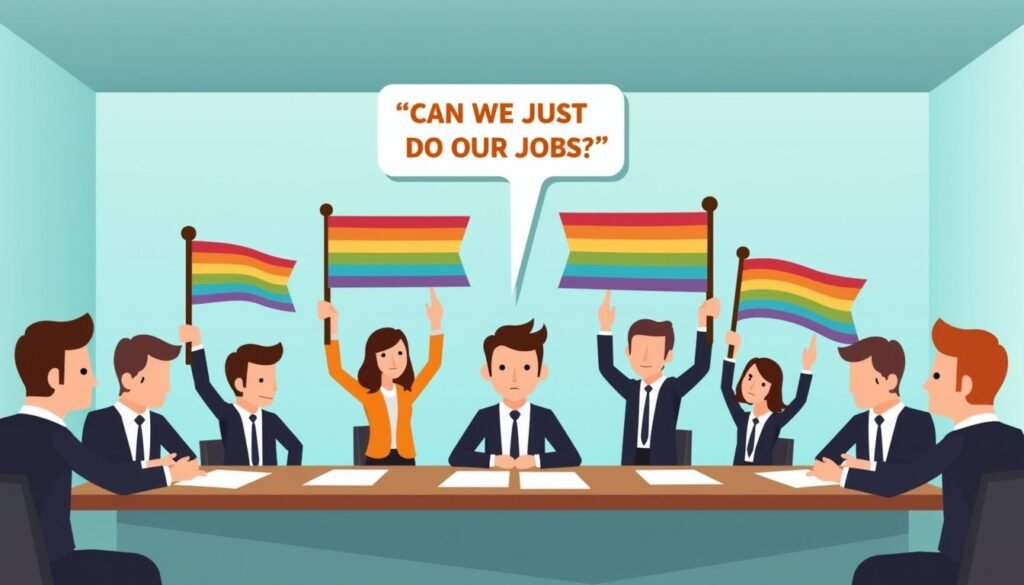
To understand why this movement has become so pervasive, we first need to break down what woke ideology actually is, where it came from, and why it sparks such fierce debate.
At its heart, woke culture is built on the belief that society is structured around power imbalances. It assumes that every system — from education to business to politics — is rigged in favor of the “privileged” and against the “marginalized.” While this framework is not new, its aggressive enforcement and expansion into everyday life are unprecedented.
Woke ideology thrives on redefining language and shifting cultural norms. Words once considered neutral — like “woman,” “family,” or “fairness” — are reinterpreted through a political lens. Practices once considered normal, such as hiring based on merit or teaching history factually, are criticized as tools of systemic oppression. The ideology is less about tolerance and more about compulsory agreement. Disagreement is painted as harmful, even violent.
To critics, this is where the danger lies. A worldview that claims to champion diversity ironically eliminates diversity of thought. Universities, once proud bastions of debate, now silence dissenting voices. Corporations, instead of focusing on excellence, spend millions on virtue-signaling campaigns. And social media platforms act as enforcers, censoring anyone who dares challenge the narrative.
Understanding the roots and mechanisms of woke ideology is essential before we can see how it spreads into schools, businesses, and culture.
Origins of the Woke Movement
The roots of woke ideology trace back to critical theory, a school of thought that emerged in the mid-20th century. Academics argued that traditional Western values — meritocracy, free markets, and individual liberty — weren’t neutral but tools of oppression. Over time, these ideas expanded into Critical Race Theory (CRT), gender studies, and intersectionality.
By the 2010s, these theories moved beyond academic journals and into mainstream activism, gaining momentum through social media movements like #BlackLivesMatter and later #MeToo. The explosion of identity politics online gave activists powerful tools to shame, pressure, and cancel dissenters. What started in academia had become cultural law.
Core Beliefs and Narratives
At its core, woke ideology rests on three main narratives:
- Identity over individuality – People are judged primarily by race, gender, or sexuality, not their personal character or achievements.
- Oppressor vs. oppressed – Society is viewed as a zero-sum power struggle, with one group always benefiting at another’s expense.
- Equity over equality – Instead of equal opportunity, the focus is on equal outcomes, often through forced redistribution or quotas.
These beliefs frame almost every conversation in woke circles, from education to entertainment.
Why It Sparks Division
The reason woke ideology sparks so much division is simple: it imposes a worldview that demands agreement while punishing dissent. Instead of encouraging open debate, it labels critics as bigots or oppressors.
For example:
- Question CRT in schools? You’re accused of being racist.
- Oppose radical gender theory? You’re branded transphobic.
- Criticize woke corporations? You’re told you’re intolerant.
This moral absolutism leaves no room for nuance or healthy disagreement. It fractures communities, pits colleagues against each other, and leaves many afraid to speak freely.
Woke Indoctrination in Schools
If there’s one place where woke ideology has made its deepest mark, it’s in education. Classrooms — once spaces for learning math, science, and history — are increasingly becoming battlegrounds for ideological wars.
The shift is most visible in curriculum changes. Across the U.S., lesson plans are being rewritten to highlight systemic racism, colonial oppression, and identity politics. Instead of teaching history as a record of human achievement and struggle, some curriculums frame it almost entirely as a tale of oppression by Western civilization.
Equally concerning is the push for gender ideology in schools. Children as young as five are being introduced to concepts like gender fluidity and encouraged to question their biological identity. In some districts, schools even allow students to socially transition without informing parents. This has sparked outrage among families who believe schools should teach basic academics, not push contested social theories.
Parents are increasingly pushing back. School board meetings across the country have turned into heated debates, with parents demanding transparency and the right to influence what their children are taught. This growing resistance shows that the classroom has become one of the most critical battlegrounds in the fight against woke culture.
Higher Education: The Woke Stronghold
While elementary and secondary schools are increasingly influenced by woke ideology, universities have long been its central breeding ground. For decades, higher education institutions have incubated the ideas that would later trickle into mainstream culture. What used to be spaces for rigorous debate and diverse perspectives are now often viewed as echo chambers of progressive orthodoxy.
College campuses are notorious for their speech codes, safe spaces, and cancel campaigns. Students who step outside of woke boundaries — whether by questioning identity politics, supporting free markets, or defending traditional values — risk being publicly shamed, silenced, or even penalized academically. Events featuring conservative or non-woke speakers are routinely shut down by protests, sometimes escalating into violence. The message is clear: conform or be ostracized.
Professors, too, play a significant role in pushing ideology. Many prioritize activism over education, using classrooms as platforms for indoctrination. Students aren’t just learning about history, politics, or sociology — they’re being taught how to view the world through a rigid woke lens. This undermines academic freedom and discourages critical thinking.
The problem extends beyond humanities and social sciences. Even STEM fields have been affected, with some institutions implementing diversity quotas for research teams or reshaping scientific language to avoid offending sensibilities. Instead of focusing on innovation and merit, academia increasingly prioritizes identity.
The result? A generation of graduates trained not to think critically but to conform ideologically — many of whom go on to become journalists, teachers, HR managers, and cultural influencers. In other words, higher education doesn’t just absorb woke culture — it exports it into every corner of society.
Safe Spaces and Censorship on Campus
The concept of safe spaces was originally intended to provide comfort for marginalized students. But it has expanded into a culture where any challenging idea is seen as dangerous. Books are banned, speakers are shouted down, and discussions are restricted to avoid “harmful” topics.
For example, students demanding safe spaces have pressured universities to cancel events featuring controversial figures. Sometimes, they don’t even let the events begin — they storm lecture halls, pull fire alarms, or scream down the speakers. These actions reveal a troubling reality: free speech is no longer valued on many campuses. Instead, emotional comfort is prioritized over intellectual rigor.
Professors Pushing Ideology Over Education
It’s no secret that many professors openly embrace activism. Surveys reveal a stark political imbalance in academia, with progressive professors vastly outnumbering conservatives. This translates into classroom dynamics where students who disagree with woke narratives feel pressured to stay silent.
Instead of encouraging debate, professors often present progressive ideology as fact. Some even require students to adopt certain viewpoints in assignments, punishing those who dissent. In this environment, higher education becomes less about expanding minds and more about enforcing conformity.
Corporations Going Woke
While schools and universities plant the seeds of woke ideology, corporations have become its loudest megaphone. Once neutral entities focused on providing products and services, many major companies now embrace progressive politics as part of their brand identity.
The shift became particularly visible after 2020, when corporations rushed to showcase their commitment to social justice causes. They rolled out diversity training programs, changed logos to rainbow colors during Pride Month, and issued statements aligning with activist movements. To executives, this was a way to show they were “on the right side of history.” But for millions of consumers, it came across as empty virtue signaling.
Employees feel the impact as well. Corporate training sessions often force workers to sit through mandatory lessons on privilege, microaggressions, and unconscious bias. Instead of uniting workplaces, these programs often sow division by labeling people according to race or gender. Some employees fear speaking openly, worried that an offhand comment might be reported to HR as a violation of company culture.
Perhaps the most damaging aspect is the way corporations now insert ideology into marketing. From children’s clothing lines to beer commercials, companies are using their platforms not just to sell products but to promote political messages. The backlash has been swift, with boycotts and plummeting sales proving that many Americans don’t want politics with their purchases.
The phrase “Go Woke, Go Broke” has become a rallying cry — and real-world data shows it’s more than just a slogan.
Diversity, Equity, and Inclusion (DEI) Programs
DEI initiatives have exploded in corporate America, becoming billion-dollar industries. The stated goal is to create more inclusive workplaces. But in practice, many of these programs operate like ideological re-education camps.
Employees are taught to view each other not as colleagues with unique skills, but as representatives of demographic categories. Workshops encourage confessions of privilege and guilt, creating resentment rather than unity. In some cases, hiring and promotions are based on identity quotas rather than merit, leading to frustration among workers who feel overlooked.
While companies claim these programs boost productivity and morale, studies show the opposite: DEI often increases workplace tension and reduces trust.
Virtue Signaling in Advertising
From Nike’s Colin Kaepernick campaign to Bud Light’s disastrous partnership with Dylan Mulvaney, advertising has become a frontline for woke branding. Companies seem more interested in making political statements than selling products.
The irony is that many of these same corporations operate in countries where human rights abuses are rampant — yet they stay silent there while lecturing Americans at home. This hypocrisy has only fueled public cynicism. Consumers increasingly see woke advertising not as authentic concern but as calculated pandering.
“Go Woke, Go Broke” Examples
Several major corporations have learned the hard way that embracing woke ideology can backfire.
- Bud Light faced one of the largest consumer boycotts in recent history after partnering with a transgender influencer. Sales tanked, and the brand lost its top spot in the U.S. beer market.
- Target received backlash for pushing LGBTQ-themed merchandise aimed at children, leading to plummeting stock value.
- Disney has faced sharp criticism for prioritizing progressive messaging in films, alienating families who once trusted the brand for wholesome entertainment.
These examples prove a critical point: while woke ideology may dominate corporate boardrooms, it doesn’t always resonate with everyday Americans.
Hollywood and Media Influence
If schools plant the seeds of woke ideology and corporations amplify it, Hollywood and mainstream media serve as its cultural megaphone. For decades, the entertainment industry has been a powerful driver of social trends, shaping how people think, dress, and talk. But in recent years, movies, television, and news outlets have shifted from storytelling and reporting to social engineering.
Woke ideology in entertainment often comes disguised as “representation” or “inclusivity.” While those sound like noble goals, the execution frequently feels forced and politically motivated. Long-loved characters are rewritten to fit ideological narratives, and new shows are designed less to entertain and more to “educate” audiences on progressive talking points.
This heavy-handedness has not gone unnoticed. Audiences increasingly feel like they’re being lectured instead of entertained. Box office failures and low ratings reflect a growing disconnect between media elites and the general public. Many Americans watch older movies and classic TV reruns because they provide something Hollywood no longer reliably offers: escapism without politics.
The mainstream news media, meanwhile, often acts as the watchdog for woke ideology, policing speech and framing events in ways that support progressive narratives. Stories are filtered, exaggerated, or downplayed depending on how they align with cultural orthodoxy. For readers and viewers, this creates an environment where it’s hard to trust whether they’re getting facts or ideological spin.
The combined effect of Hollywood and media influence is profound. From subtle messaging in children’s cartoons to overt political commentary in blockbuster films, woke ideology is embedded in the culture pipeline that shapes the next generation. And for critics, this represents not art, but propaganda wrapped in entertainment.
Woke Storytelling in Film and TV
Once upon a time, Hollywood focused on telling great stories with universal themes: love, heroism, sacrifice, redemption. Today, many films and shows prioritize political checklists over creativity. Characters are no longer developed for their depth or relatability but for their ability to represent specific identities.
Take recent superhero movies or fantasy franchises. Instead of expanding beloved universes with fresh storytelling, producers increasingly insert political messaging — often at the expense of coherent plots. Audiences notice when they’re being preached to, and they’re voting with their wallets. Box office bombs and failed streaming projects are piling up as evidence that forcing ideology doesn’t equal good storytelling.
Celebrities as Activists, Not Entertainers
Celebrities used to be admired for their talent. Today, many are admired — or criticized — for their activism. Red carpet events, award shows, and social media feeds are filled with political sermons. Actors, musicians, and influencers are expected not just to perform but to signal their allegiance to woke causes.
The problem is that this alienates audiences. Many fans just want to enjoy a movie or a song without being lectured. Yet, when celebrities double down on activism, they risk alienating huge swaths of their fan base. And because Hollywood operates as a tight-knit echo chamber, few are willing to break ranks, even if the backlash hurts their careers.
The Role of Big Tech and Social Media
While Hollywood spreads woke ideology through storytelling, Big Tech enforces it through control of information. Platforms like Facebook, Twitter (now X), YouTube, and TikTok have enormous influence over what people see, hear, and say. And increasingly, these platforms are accused of tilting the conversation toward progressive orthodoxy.
One of the most obvious tools is censorship. Users who question woke narratives — whether about gender theory, COVID policies, or racial politics — risk being shadow-banned, suspended, or permanently deplatformed. This has created an online culture where millions self-censor, fearful of losing their accounts, audiences, or livelihoods.
Algorithms also play a massive role. Social media companies tweak what content gets promoted, what goes viral, and what disappears into obscurity. Unsurprisingly, content that aligns with woke ideology often rises to the top, while dissenting voices struggle to be seen. This invisible manipulation ensures that even if platforms claim neutrality, the outcome is far from balanced.
The result is a digital public square where speech is technically free, but not equally heard. Big Tech, acting as the gatekeeper, has become a de facto enforcer of ideological boundaries, subtly guiding culture in a progressive direction while silencing opposition.
Censorship and Deplatforming
The list of high-profile individuals banned from platforms grows each year. Politicians, journalists, comedians, and everyday users have all been silenced for breaking unwritten rules of woke discourse. What’s striking is that the definitions of “hate speech” or “misinformation” are often fluid, changing with the political winds.
This selective enforcement creates mistrust. People see satire accounts or conservative voices silenced, while inflammatory rhetoric from left-wing activists remains untouched. The inconsistency suggests censorship isn’t about safety, but about ideology.
Algorithms That Promote Woke Agendas
Even without outright bans, algorithms shape culture by promoting what’s “acceptable.” TikTok, Instagram, and YouTube feed billions of users content that aligns with progressive ideals. Videos celebrating radical gender theory or racial activism are boosted, while critiques remain buried.
Most users don’t even realize they’re being influenced — they simply assume what they’re seeing reflects popular opinion. In reality, algorithms create an illusion of consensus, convincing people that woke ideology is mainstream, when in fact, many disagree but remain invisible online.
Everyday Life Under Woke Culture
What makes woke ideology so powerful isn’t just its presence in schools, businesses, or media — it’s how it filters down into daily life. Ordinary Americans now feel its impact in their workplaces, communities, and even personal relationships.
Take the workplace, for example. Employees are required to use “inclusive” language, attend diversity seminars, and adhere to unwritten codes of political correctness. A casual conversation or joke could be reported to HR, leading to disciplinary action. This creates an environment of fear and compliance, where people prioritize self-censorship over authenticity.
Language itself has become a battlefield. Words that were once neutral or scientific are now redefined. Gender pronouns, for instance, have sparked heated debates. Employees, students, and even parents are pressured to adopt new terms or risk being labeled intolerant. For many, this feels less like respect and more like forced conformity.
Even outside of work, woke ideology seeps into friendships and families. Disagreements over politics or culture can fracture relationships, with some cutting ties over ideological differences. Communities that once bonded over shared traditions now find themselves divided by cultural battles imported from social media.
Perhaps the most damaging consequence is the erosion of free expression. People hesitate to share opinions at dinner tables, churches, or online forums. The chilling effect doesn’t just silence “offensive” voices — it silences everyone, robbing society of the open debate that once fueled progress.
Workplace Politics and Mandatory Training
In countless companies, mandatory DEI training has become a yearly requirement. Employees are lectured about privilege, microaggressions, and unconscious bias, often with exercises designed to expose their supposed complicity in systemic oppression.
Instead of uniting teams, these sessions frequently foster resentment. Some feel unfairly blamed, while others feel tokenized. Productivity suffers as employees spend more time navigating ideological landmines than focusing on their actual work.
Language Policing and Pronoun Wars
Nowhere is woke ideology more visible than in the fight over language. Pronouns, once a straightforward part of grammar, have become a cultural minefield. Some workplaces demand employees announce pronouns in meetings or email signatures. Others enforce disciplinary measures if someone “misgenders” a colleague, even accidentally.
Critics argue this isn’t about respect but control — forcing people to adopt language that aligns with an ideology they may not believe in. For many, it feels like an intrusion into free speech and a dangerous precedent for compelled speech.
The Erosion of Free Expression
The most profound consequence of woke culture is the chilling effect on free speech. When people fear that a wrong word or unpopular opinion could cost them friends, jobs, or reputations, they stop speaking openly.
This creates a culture of silence, where real conversations are replaced by cautious platitudes. And when honest debate disappears, society loses its ability to find truth. The erosion of free expression doesn’t just harm individuals — it harms democracy itself.
The Pushback Against Woke Ideology
As woke ideology spreads, so too does the resistance against it. Across the U.S. and beyond, a pushback is gaining momentum — from parents at school board meetings to workers tired of corporate politics. What’s clear is that millions of people are no longer willing to quietly accept cultural shifts that feel imposed rather than chosen.
This resistance isn’t just political; it’s deeply personal. Parents see their children being indoctrinated. Workers feel silenced in their own offices. Consumers resent being lectured when all they wanted was a product or service. At every level of society, ordinary people are saying enough is enough.
Grassroots movements are springing up to challenge school curriculums, organize boycotts, and protect free speech. These groups often operate outside traditional political parties, drawing energy from everyday citizens who feel ignored by mainstream institutions. Their message is simple: culture belongs to the people, not to elites or activists.
Perhaps most telling is the way backlash is shaping spending habits. Boycotts against woke corporations have cost billions in revenue. Parents are pulling kids from schools, seeking alternative education. Workers are leaving jobs that demand ideological conformity. The pushback is proving one thing: while woke ideology may dominate institutions, it does not dominate hearts and minds.
Grassroots Movements and Protests
Across the country, parents are packing school board meetings to demand transparency in education. They’re calling for an end to divisive curriculums and pushing for schools to return to basics: reading, writing, math, and factual history. In some districts, these efforts have led to sweeping changes in policy, proving that grassroots pressure works.
Meanwhile, protests against woke corporate practices are becoming more frequent. From boycotts to viral campaigns, everyday consumers are finding ways to make their voices heard. Social media, ironically, has become a tool for anti-woke organizing, allowing people to connect, share stories, and mobilize against powerful institutions.
Parents, Workers, and Consumers Fighting Back
Parents are withdrawing children from public schools in record numbers, turning to homeschooling or private institutions that reject woke indoctrination. Workers are quietly resisting mandatory DEI sessions by refusing to participate or speaking out against policies they view as discriminatory. Consumers, fed up with corporate virtue signaling, are shifting their dollars to companies that remain neutral.
This collective resistance may not always make headlines, but it’s reshaping the cultural landscape. The message is spreading: you don’t have to accept woke ideology as the default.
Why the Anti-Woke Rebellion is Growing
The rise of the anti-woke movement is not a passing trend — it’s a growing cultural force fueled by frustration and a desire for freedom. People are tired of being told what to think, how to speak, and what to believe. They’re tired of a culture that punishes dissent and rewards conformity.
At its heart, the rebellion is about reclaiming common sense. It’s about defending the idea that people should be judged by their character, not their identity. It’s about protecting free speech, preserving traditions, and creating a society where disagreement is allowed without fear of cancellation.
The anti-woke rebellion is also fueled by hypocrisy. Many Americans see elites lecturing them about morality while living lives of luxury, free from the consequences of the very policies they promote. This double standard breeds resentment and drives people toward movements that champion authenticity and fairness.
The more woke ideology tries to silence opposition, the stronger the resistance becomes. For every person canceled, dozens more wake up to the dangers of cultural conformity. That’s why the anti-woke rebellion isn’t just growing — it’s accelerating.
The Desire for Free Speech
At the center of the rebellion is a hunger for free speech. People don’t want to live in fear of saying the wrong thing. They want to be able to debate, disagree, and joke without worrying about losing their livelihoods. Free speech is the cornerstone of democracy, and when it’s threatened, people will fight to protect it.
Preserving Traditional Values
For many, resisting woke ideology is about more than free speech — it’s about preserving traditions that anchor society. Family, faith, patriotism, and meritocracy are values that have guided generations. Woke culture often seeks to dismantle or redefine these values, leaving people feeling unmoored. The rebellion is a way of holding onto principles that provide stability and meaning.
FAQs About Woke Ideology
1. What does “woke” really mean?
Originally, woke meant being alert to social injustice. Today, it’s often used to describe a political ideology focused on identity, equity, and progressive activism — frequently enforced through social pressure and censorship.
2. Why is woke ideology considered dangerous by critics?
Critics argue it suppresses free speech, divides people by identity, and prioritizes ideology over merit, truth, and individuality. It often punishes dissent, creating a culture of fear rather than open debate.
3. How has woke ideology entered schools?
Through curriculum changes that emphasize identity politics, Critical Race Theory, and gender theory. Parents argue this replaces academics with activism and undermines parental authority.
4. Why do corporations embrace woke culture?
Many companies adopt woke branding to appear progressive and avoid backlash. However, this often backfires when consumers see it as inauthentic or feel politics shouldn’t be mixed with products.
5. What is meant by “Go Woke, Go Broke”?
It’s a phrase describing how companies that embrace woke ideology often face consumer boycotts and financial losses, as seen with brands like Bud Light, Target, and Disney.
6. Is the anti-woke movement political or cultural?
It’s both. While it influences politics, the movement is primarily cultural — driven by parents, workers, and consumers who want to protect free speech, traditional values, and common sense.
7. Can woke and anti-woke movements coexist?
In theory, yes. But in practice, woke ideology often rejects coexistence, demanding conformity. The anti-woke response arises because many feel they can’t simply “live and let live.”
8. What can individuals do to resist woke culture?
Speak up, support businesses that stay neutral, attend school board meetings, and refuse to participate in compelled speech. Small acts of resistance collectively make a big impact.
The Battle for America’s Cultural Future
Woke ideology has crept from classrooms to corporations, from Hollywood to households. It influences how people talk, what they learn, and even what products they buy. But as it spreads, so does the resistance. The anti-woke movement is proof that millions refuse to surrender their voices, values, and freedoms.
This battle isn’t just political — it’s cultural. It’s about whether society will embrace open dialogue, personal freedom, and timeless values, or whether it will succumb to rigid orthodoxy and ideological conformity.
The good news? Resistance is growing. Parents are reclaiming schools, consumers are rejecting woke corporations, and everyday people are demanding honesty, freedom, and sanity. The future of culture is far from decided — and the rebellion against woke ideology shows no signs of slowing down.