Imagine a committee announcing a new commitment to open debate, followed by a twelve-page form explaining which opinions are permitted. You could write a lengthy response about the contradiction. Or you could ask whether the freedom comes with a permission slip. Sometimes a small joke gets to the point before the official explanation has finished clearing its throat.
That is why humour is our preferred answer to the preachier side of political correctness. We are not claiming it works in every situation, or that laughter proves an argument. Serious harm needs serious attention. But when the problem is self-importance, compulsory solemnity or an obvious double standard, a well-aimed joke can be more useful than another hour of furious commentary.
Political correctness is not the same thing as ordinary courtesy
Before defending the joke, define the target. Being considerate towards another person is not automatically ideological surrender. Avoiding an unnecessary insult at a family gathering does not mean somebody has confiscated your freedom. A world in which nobody ever exercises tact would be unpleasant, not admirably independent.
Our objection is different. It concerns the expectation that contested beliefs must be treated as unquestionable, that approved terminology can substitute for clear thinking, or that disagreement should establish somebody’s moral unfitness before their point has been heard. Those habits deserve scrutiny. So does the tendency to treat every badly worded remark as though it reveals a complete theory of evil.
Humour becomes useful when it draws attention to one of those specific habits. It becomes lazy when “political correctness” simply means “I would like to insult someone without criticism.” The distinction matters. If your joke has a point, you should be able to identify it without needing the target to be an entire category of people.
A joke can expose the contradiction in one step
Suppose a hypothetical organisation says everyone is encouraged to speak honestly, but requires every contribution to affirm the same disputed conclusion. The contradiction is the target. “Open debate, provided the outcome is booked in advance” puts the tension into a sentence. It does not need to guess the inner life of every employee.
This kind of humour works, in our view, because it makes the mechanism visible. You can see what is being advertised and what is actually required. The joke compresses the comparison. It can then be followed by a serious question: what counts as disagreement here, and what happens when someone expresses it?
The compression is also the limitation. A sentence can leave out an important safeguard or an exception. If somebody points out that your example misrepresents the rule, examine the correction. A funny description of a policy that does not exist is still a false description. Wit does not supply a special exemption from getting the facts right.
Anger can accidentally accept the rules of the performance
A solemn claim often invites a solemn reaction. Before long, both participants are competing to demonstrate that their side possesses the greater moral urgency. The topic becomes secondary to the spectacle. Even an accurate objection can lose its shape when it is wrapped in a declaration that the entire world is ending.
Humour offers a different response: perhaps the claim is not too sacred to question, but too inflated to deserve the level of reverence being demanded. That is not the same as saying nothing matters. It is a judgement about scale. Some nonsense is best answered with proportion rather than an emergency siren.
Our article on the outrage economy explores the temptation to keep every disagreement at maximum temperature. A joke can be one way to refuse that invitation. You do not have to match an institution’s theatrical seriousness with your own equally theatrical fury. Sometimes the useful response is to show where the balloon has been overinflated.
Make the rule the target, not the person’s existence
A strong satirical target might be a contradictory policy, selective principle, inflated claim or performative gesture. A weak one is often a stranger’s appearance, accent or ordinary difference. The first can reveal something about the argument. The second may simply reveal that you noticed somebody you could make uncomfortable.
For example, a hypothetical campaign declaring itself inclusive while excluding every dissenter gives you a mechanism to question. Mocking an unrelated person associated with the campaign does not establish that mechanism. It can distract from your best point by replacing a clear criticism with a personal humiliation.
You are not obliged to make every joke gentle. Satire can be sharp. The issue is whether the sharpness serves the point or replaces it. Ask yourself what the audience is meant to notice. If the only answer is “this person is ridiculous because I dislike them,” the joke may have very little argument hiding underneath its confidence.

Being offended does not settle the argument
A person can be offended by a joke without proving that its underlying criticism is wrong. Equally, the joke can be inaccurate or cruel without the objection proving that its target is secretly afraid of the truth. Reactions are reactions. They deserve context; they do not automatically decide the factual question.
This is where a familiar bad habit appears on both sides. One person says, “Someone disliked it, therefore it must be prohibited.” Another says, “Someone disliked it, therefore it must be brilliant.” Neither conclusion follows just from the dislike. You still need to examine the content, the setting, the target and what actually happened.
Our piece on disagreement and harm makes the broader distinction. A society with room for expression will include material some people strongly dislike. That does not mean every objection is illegitimate, and it does not mean every objection should control the available conversation. You can defend the space for a joke while accepting that people may criticise it.
Do not turn “just a joke” into an escape hatch
Humour does not make you immune from responsibility for what you said. If a joke contains a factual accusation, the accusation still matters. If it repeats a false story, the punchline does not repair the falsehood. If it is directed repeatedly at an unwilling individual, describing it as comedy does not automatically make the situation harmless.
You can explain your intention without insisting that intention settles every question. Sometimes the audience misunderstood the target. Sometimes your wording failed. Sometimes you discover that the idea was less clever than it seemed while you were annoyed. None of those possibilities requires the abolition of humour. They require the ability to review one particular joke.
That review can be calm. You might say, “I was criticising the rule, not making a claim about that person.” You might also decide to rewrite it. Revision is not always capitulation. A clearer joke can be a sharper joke. Protecting every weak line as though it were the last surviving fortress of free expression gives bad writing far too much importance.
The audience does not owe you laughter
You have the freedom to make an observation; the audience has the freedom not to enjoy it. That arrangement is healthier than demanding either automatic approval or automatic prohibition. A person may walk away, change the subject or tell you the joke is rubbish. The possibility is part of expressing something in public.
In ordinary conversation, notice whether people have chosen to participate. A willing friend exchanging jokes with you is not the same situation as a colleague trying to complete a task while you keep escalating. Context changes what the joke does. It can be a moment of shared recognition or an interruption someone cannot easily escape.
If it falls flat, resist the urge to become a lecturer on why everyone lacks a sense of humour. That rarely improves the atmosphere. You can make a brief clarification and move on. The ability to let a failed joke go is often more confident than the demand to have it formally recognised as an important contribution to civilisation.

Satire can invite a serious question
The best follow-up to a joke is not necessarily a second, louder joke. It may be a question. “Why is the feedback compulsory if the exercise is voluntary?” “Would you apply that rule to an organisation you dislike?” “What evidence would show that this approach is failing?” The humour notices the inconsistency; the question tests it.
This is how irreverence can contribute to a useful discussion rather than merely provide entertainment for your own crowd. Someone who would reject a full speech may still recognise a contradiction, but recognition is only an opening. Give them something concrete to examine. Do not treat a smile as a signed declaration of allegiance.
Nor should you invent evidence that humour always changes minds more successfully than a serious explanation. We are expressing an editorial preference for certain kinds of cultural argument, not reporting a universal scientific ranking of persuasion methods. If the situation requires detailed evidence, careful listening or a sober explanation, use those things. The right tool depends on the task.
Let your own side be funny too
An anti-woke culture that cannot laugh at itself is in danger of rebuilding the solemnity it criticises. There is plenty to notice: the person demanding independent thought while repeating every line from a favourite commentator, or the permanent outrage merchant who claims to be defending everybody’s right to relax.
Those contradictions should not become untouchable merely because the speaker uses familiar slogans. If your objection is to dogmatism, it should survive encountering dogmatism among people you like. Otherwise your satire is not a defence of open thinking; it is an entertainment service for a team that wants its opponents mocked and its own habits protected.
Self-awareness helps. You can admit that you have spent too long arguing with an account whose profile picture is a furious cartoon animal. You can notice when a minor disagreement has swallowed your whole evening. Laughing at that does not erase the issue. It gives you a way to recover a sensible relationship with its importance.
Why the slogan works as clothing
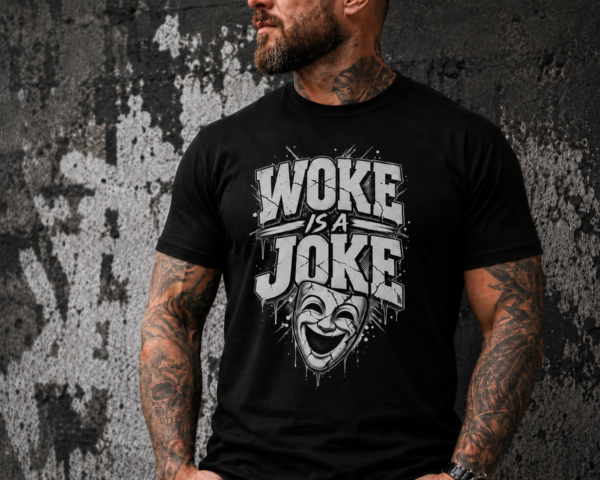
Woke Is a Joke makes our irreverent attitude visible. It is not a technical definition of every use of “woke,” and it is not proof that every progressive idea is ridiculous. It is a deliberately blunt expression of resistance to the dogmatic cultural habits we criticise. The conversation beyond the slogan still belongs to the wearer.
That is why the rest of your conduct matters. If you wear a humorous message and react angrily to every question about it, the contradiction becomes rather easy to spot. If you can explain the target, hear a criticism and enjoy a little self-directed humour, the attitude is much more coherent.
For a broader expression of the underlying principle, Think for Yourself shifts the emphasis from the joke to independent judgement. Neither choice requires you to spend the day trying to provoke strangers. A message can be part of your style without turning the whole outfit into a full-time argument.

Keep the punchline—and the proportion
Humour can make room for disagreement by refusing to treat every fashionable claim as a sacred object. It can point out a double standard, puncture self-importance and let an ordinary conversation breathe. But it remains a tool, not a licence to abandon accuracy or an excuse to confuse contempt with insight.
That is the balance we want: a serious commitment to free thought, accompanied by the ability to laugh at nonsense and occasionally at ourselves. If that sounds like your style, browse the Rise & Defy collection. Wear the message, keep your judgement, and remember that not every absurdity deserves an evening of anger.