Customers Asked for a Product, Not a Sermon
A customer walks into a shop, opens an app or visits a website because they want something useful, enjoyable or well made. They are not usually searching for moral instruction from a corporation whose customer-service queue already takes forty minutes.
Corporate wokeness ignores that obvious truth. It persuades executives that every logo must become a campaign badge, every calendar date needs an approved statement and every silence will be interpreted as guilt. The company begins speaking like a political pressure group with a sales department attached.
The result is rarely courage. It is committee-built activism: cautious enough to protect executives, fashionable enough to attract online praise and vague enough to avoid measurable responsibility. Customers notice the performance — especially when the basic product is getting worse.
Where the Argument Goes Wrong
Companies are free to hold values and sometimes should speak on issues that directly affect their staff, customers or operations. The error is treating constant political commentary as a universal duty rather than a strategic choice.
A brand serves a broad public. Turning every purchase into a referendum on the latest cultural dispute narrows that public for no commercial reason. Worse, it may drag employees into an argument they never agreed to represent.
Social Media Is Not the Market
A loud group on social media can create the impression that a brand faces one overwhelming demand. In reality, many customers are offline, indifferent or quietly opposed to the campaign. This is not a complaint about ordinary courtesy. It is a complaint about turning courtesy into doctrine, doctrine into policy and policy into a loyalty test. Each step makes honest correction harder.
Executives optimise for a few days of digital applause and overlook the slower behaviour of customers who simply stop buying. The backlash arrives in sales data after the activists have moved on. A rule designed to prevent discomfort soon produces a different kind of discomfort: the permanent anxiety of not knowing which ordinary phrase, joke or opinion will be reclassified tomorrow.
Research the actual customer base before adopting a political identity. Sentiment from employees, buyers and long-term brand data matters more than a trending pile-on. The repair begins with viewpoint neutrality. Protect the right to speak for people you dislike, measure everyone by the same standard and let evidence outrank fashionable vocabulary.
Values Become a Shield for Weak Performance
Political messaging can give an ordinary company the flattering feeling that it is changing the world. That emotional reward is tempting when fixing delivery, quality or service would be slower and less glamorous. The issue is bigger than a silly slogan or an irritating social-media row. Repeated often enough, the habit trains people to judge statements by the speaker’s perceived tribe rather than by whether the statement is true.
Customers grow angrier because the moral lecture sits beside visible incompetence. A company that cannot answer an email looks ridiculous explaining how society should behave. Instead of solving the original issue, the policy creates a second problem around it: resentment. People who might have supported a practical reform begin opposing the whole project because coercion has poisoned it.
Earn trust through the core job first. A reliable product, fair employment and honest support demonstrate values more convincingly than another statement written by a committee. Where a genuine unfairness exists, address it directly and measure the result. Broad ideological rituals often flourish precisely because they are easier to announce than a specific problem is to solve.
Employees Become Political Props
Corporate campaigns are often described as the voice of the workforce even though no workforce shares one political mind. Staff may feel pressure to attend events, display symbols or repeat positions unrelated to their role. The sensible position is not that feelings never matter. Feelings plainly matter. The mistake is giving one person’s reaction automatic authority over everyone else’s speech, judgment or opportunity.
The employer turns colleagues into competing identity camps and makes professional belonging depend on political performance. People who remain neutral are treated as suspicious rather than focused. The loudest campaigners may call that progress, but compliance is not conviction. A person forced to repeat a phrase has not been persuaded; they have merely been taught when to remain silent.
Protect voluntary participation and viewpoint diversity. Employees should be evaluated on their work and conduct, not on their enthusiasm for internal activism. People should be free to change their minds without humiliation. A culture that allows correction will learn; a culture that demands flawless ideological performance will merely become better at hiding its errors.
Customers Can Feel the Contempt
The worst corporate activism assumes dissenting customers are backward people who must be educated. Marketing stops inviting and starts scolding, often with a smugness no ordinary salesperson would dare use face to face. Once status comes from displaying the approved view, the debate changes. People stop asking what is accurate or useful and start asking what they are expected to say. That is public relations, not thought.
Customers do not need to organise a boycott to punish that attitude. They can choose a competitor, tell a friend and never provide the brand with a helpful explanation. Every exception makes the principle less believable. When standards change according to identity or politics, people stop seeing fairness and start seeing favouritism with better branding.
Speak to customers as adults. A broad brand can express a principle without insulting everyone who interprets a complex issue differently. Common sense asks what behaviour a rule encourages, not what emotion inspired it. That single shift exposes many fashionable policies that feel virtuous at launch and become absurd in practice.
Mission Drift Has a Real Price
Every hour spent debating symbolic campaigns is an hour not spent on products, operations or customers. Large companies can hide that cost for a while, but they cannot repeal it. The trick is subtle: a debatable claim is wrapped in the language of kindness until disagreement sounds cruel. But good intentions do not make an idea correct, and moral confidence is not a substitute for proof.
Internal politics expands because status can be gained through language rather than delivery. Teams learn that a visible campaign may advance a career faster than quiet competence. The immediate result is a quieter room and a worse decision. Sensible objections stay private, activists mistake silence for agreement, and a weak proposal survives because questioning it appears personally expensive.
Tie public positions to the company’s mission and measurable responsibilities. If an issue has no clear connection to either, corporate neutrality is not cowardice; it is focus. Institutions should return to their actual job. A school should teach, a company should serve customers and a public body should serve the public. Political theatre is not a substitute for competence.
The Strongest Defence — and Why It Still Falls Short
Supporters argue that consumers expect brands to take stands. Some certainly do, and a founder-led company may choose an unmistakable identity — Rise & Defy included. The difference is honesty and audience fit.
A political brand should say what it is. Corporate wokeness usually pretends a contested worldview is neutral human decency and then treats customers who disagree as defective. That bait-and-switch, not the mere existence of values, creates the distrust.
Five Reality Checks Worth Applying
Before accepting the fashionable answer on corporate wokeness, strip away the moral branding and test the proposal as you would any other claim. These checks do not decide every argument automatically, but they force hidden assumptions and trade-offs into the open.
1. The consistency check: Would the rule still seem fair if political roles were reversed? Apply it to both “Social Media Is Not the Market” and “Customers Can Feel the Contempt”. A principle that becomes unacceptable when an opponent controls it is probably a temporary weapon, not a standard anyone should trust.
2. The evidence check: What observable fact would show that the policy is working, and what result would show that it is failing? If supporters interpret every possible outcome as confirmation, the claim has escaped the world of evidence and entered the safer territory of faith.
3. The incentive check: Ask what behaviour the system rewards. Does it encourage honesty, competence and resolution, or does it make grievance, silence and ideological performance more valuable? People respond to incentives even when the programme describing those incentives uses compassionate language.
4. The proportion check: Compare the proven conduct with the proposed consequence. Woke disputes often jump from a disputed phrase to the language of danger, exclusion or permanent unfitness. Civilised judgment needs a scale; without one, every disagreement becomes an excuse for maximum pressure.
5. The completion check: What would success look like, and could the people running the policy ever admit that the job was finished? A reform that can only expand will eventually serve its administrators more reliably than the public. Worthy causes should be capable of winning.
The Common-Sense Alternative
Rejecting corporate wokeness does not mean rejecting compassion, fairness or equal dignity. It means refusing to let good words excuse bad reasoning. A more durable approach begins with a few standards that work regardless of who currently holds cultural power.
- Serve before signalling: Product quality and customer care are the first public expression of company values.
- Know the audience: Do not mistake activist attention for broad customer consent.
- Keep participation voluntary: Employees are not props for executive reputation management.
- Stay mission-linked: Speak where the company has a real responsibility or relevant expertise.
- Accept commercial consequences: A strong political position may narrow the market; be honest about the trade-off.
None of these principles promises a world without offence or conflict. That is not a serious promise. They offer something better: rules that ordinary people can understand, institutions can apply consistently and opponents can challenge without fear.
Frequently Asked Questions
1. Should companies never discuss social issues?
No. They should decide deliberately, especially where an issue directly affects operations or staff. The criticism concerns reflexive, fashionable and coercive activism.
2. Is Rise & Defy being hypocritical as a political brand?
No. Rise & Defy openly sells free-speech and anti-woke designs to customers who want them. It does not pretend to be a politically neutral utility while quietly imposing an ideology.
3. Why can online praise be misleading?
Applause is visible and immediate; lost custom is quiet and delayed. The people sharing a campaign may never have bought the product in the first place.
4. What should a brand do during a cultural controversy?
Check its mission, customer expectations, employee freedom and actual responsibility. Silence is often a legitimate decision, not an admission of guilt.
Do the Job Before Saving the World
Customers are not morally improved by buying washing powder, booking a bank appointment or ordering a sandwich. Companies that forget this become easy targets for ridicule because the gap between their grand language and ordinary competence is impossible to miss.
A brand earns loyalty by being useful, distinctive and trustworthy. Politics can be part of that identity when it is honest. Preaching borrowed from the latest corporate script is something else: expensive theatre performed for an audience that may not even buy a ticket.
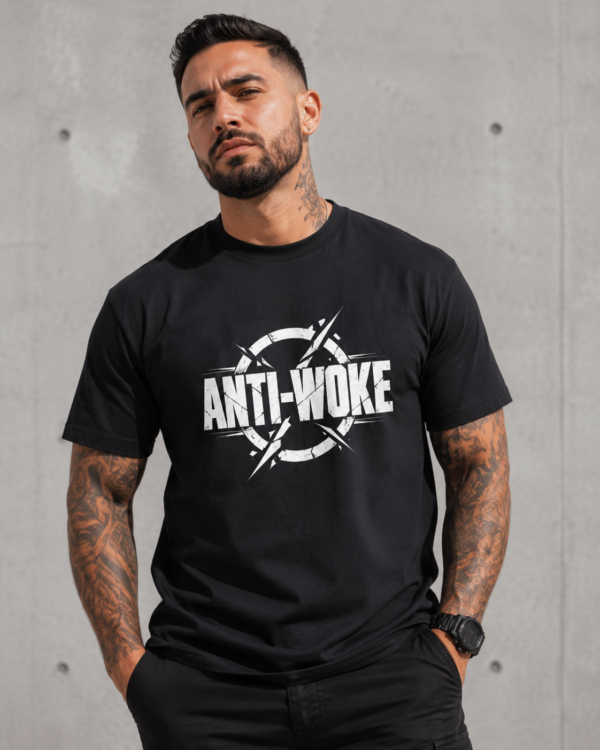
Rise & Defy exists for people who prefer honest arguments to approved scripts. If that sounds like you, explore the ANTI-WOKE T-Shirt or browse the complete Rise & Defy collection. Wear what you mean. Think for yourself.